Guide sections
On this page
On this page
Review the country’s geography, economy and international ties before choosing an investment sector.
- 01Geography and Demography
- 02Overview of the economy and key sectors
- 03International Relations and Membership in International Organizations
PDF · 11 · 2026-09-11
The source labels the first year as 2012. The value and label are retained; comparability with 2022–2025 needs confirmation from the authors. PDF ↗
- Official name
- Kyrgyz Republic
- Short name
- Kyrgyzstan
- Capital
- city of Bishkek
- Territory
- 199.9 thousand sq. km.
- Currency
- Kyrgyz som (KGS)
- Languages
- Kyrgyz – state language, Russian – official language
- Time zone
- UTC+6
1.1.General characteristics
The Kyrgyz Republic (Kyrgyzstan) is a country in Central Asia with an open market economy and a strategic location between major regional markets. Situated at the crossroads of the Great Silk Road, the country actively participates in international trade and economic processes, offering foreign investors access to a rapidly developing market with relatively low entry barriers and competitive business costs.
- Population
- 7.4 million 1
- Largest cities
- Bishkek (1.4 million), Osh (484.9 thousand), Manas2 (189.2 thousand)
- Capital
- city of Bishkek
- Administrative-territorial division
- 7 regions + 2 cities of republican significance: Bishkek and Osh
- Neighboring countries
- Kazakhstan, Uzbekistan, Tajikistan, China
National Statistical Committee of the Kyrgyz Republic, Brief Statistical Handbook "Kyrgyzstan" (April 2026), information as of January 1, 2026. Previously – city of Jalal-Abad.
1.2.Geography and Demography
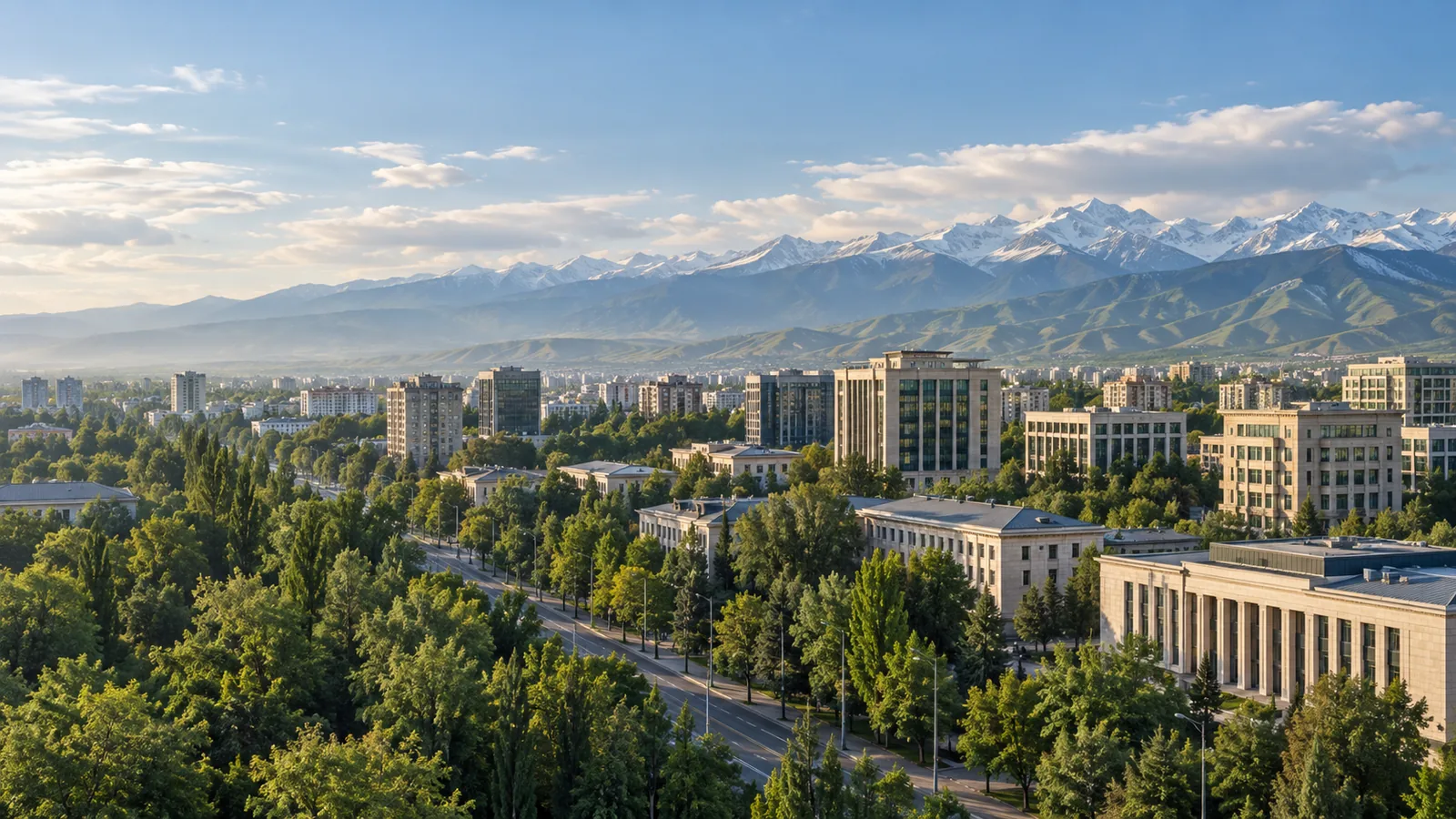
The Kyrgyz Republic is located in the very heart of Central Asia, at the intersection of major regional transport and economic routes. About 94% of the country's territory is mountainous. The country's territory combines relatively small size with significant natural and geographical diversity.
Kyrgyzstan is landlocked and borders Kazakhstan to the north, Uzbekistan to the southwest, Tajikistan to the south, and China to the east and southeast. This geographical position creates a solid foundation for developing the country's transit potential and opens attractive opportunities for expanding regional trade and strengthening transport connectivity. A significant part of the population is of working age, which forms a human resource potential for implementing investment and infrastructure projects.
1.3.Political and Administrative System
The Kyrgyz Republic is an independent, sovereign, democratic, unitary, legal, secular, and social state. State power is exercised based on the principle of separation of powers into legislative, executive, and judicial branches.
The President plays a key role in the system of state bodies: he is the head of state, the highest official, and heads the executive branch.
- State structure
- unitary
- Form of government
- presidential republic
- Legislative body
- Jogorku Kenesh (unicameral parliament), consists of 90 deputies elected for a term of 5 years
- Executive power
- President, elected for a term of 5 years (no more than 2 terms); Cabinet of Ministers headed by the Chairman of the Cabinet of Ministers
- Judicial system
- Constitutional Court, Supreme Court, local courts
- Fundamental law
- Constitution of the Kyrgyz Republic (2021)3
Adopted by referendum (nationwide vote) on April 11, 2021, and enacted by the Law of the KR dated May 5, 2021 No. 59.
1.4.Overview of the economy and key sectors
The economy of the Kyrgyz Republic is a developing economy focused on trade, services, industry, and mineral extraction. According to the World Bank classification, the republic belongs to the group of lower-middle-income countries.4
In recent years, the country's economy has demonstrated consistently high growth rates, significantly exceeding the global average for developing economies (11.1% in 2025)5, indicating a steady expansion of economic activity and the formation of a favorable macroeconomic foundation for the implementation of investment projects.
- Nominal GDP (2025)
- 22.6 billion USD
- GDP per capita (2025)
- 3.1 thousand USD
- GDP growth (2025)
- 11.1%
- Exports (2025)
- 2,852.1 million USD
- Imports (2025)
- 12,972.9 million USD6
World Bank, "Kyrgyz Republic": https://www.worldbank.org/ext/en/country/kyrgyzrepublic National Statistical Committee of the KR, Brief Statistical Handbook "Kyrgyzstan" (April 2026). National Statistical Committee of the KR, Brief Statistical Handbook "Kyrgyzstan" (April 2026). National Statistical Committee of the KR, Socio-economic situation of the KR, January-December 2025.
- Services
- 51.2%
- Construction
- 8.7%
- Industry
- 17.7%
- Agriculture
- 8%
- Net taxes on products and imports
- 14.4%
Main trading partners (foreign trade turnover, 2025)8
- China
- $4,973.9 million
- Russia
- $3,846.2 million
- Kazakhstan
- $1,867.9 million
- Uzbekistan
- $1,003.5 million
- South Korea
- $508.6 million
- Turkey
- $454.5 million
- United Kingdom
- $269.0 million
- USA
- $227.7 million
- Belarus
- $206.5 million
- Germany
- $198.1 million
- UAE
- $176.0 million
National Statistical Committee of the Kyrgyz Republic, Socio-economic situation of the Kyrgyz Republic, January 2026. National Statistical Committee of the Kyrgyz Republic, Brief Statistical Handbook “Kyrgyzstan” (April 2026), Statistical Yearbook of the Kyrgyz Republic (2020-2024).
- 2012
- 5.5%
- 2022
- 9%
- 2023
- 9%
- 2024
- 11.5%
- 2025
- 11.1%
1.5.International Relations and Membership in International Organizations
The Kyrgyz Republic actively participates in international trade and regional economic cooperation, creating additional opportunities for doing business and implementing investment projects.
Thanks to its geographical location between China, Central Asian countries, and the EAEU states, Kyrgyzstan has significant potential as a manufacturing, logistics, and trade hub for projects aimed both at the domestic market and exports to regional countries.
Additional evidence of the strengthening of international trust in Kyrgyzstan was the election of the country as a non-permanent member of the UN Security Council for 2027-2028, as well as the removal of Kyrgyzstan from the European Union's 'blacklist' on aviation safety. These decisions reflect the country's growing authority on the international stage and the strengthening of its investment attractiveness.
Eurasian Economic Union (EAEU)
- Member since 2015
- Access to a single market with a population of over 180 million people and a combined GDP exceeding 2.5 trillion USD
- Free movement of goods
- Unified customs territory
Shanghai Cooperation Organization (SCO)
- Participation in the largest regional organization of Eurasia
- Development of trade, transport connectivity, and infrastructure projects
Organization of Turkic States (OTS)
- Strengthening trade and economic cooperation among Turkic states
- Development of transport corridors and business ties in the region
Investment Protection and Taxation
- Approximately 40 agreements on the avoidance of double taxation
- More than 30 agreements on the promotion and mutual protection of investments
- International legal mechanisms for investor protection and tax optimization
World Trade Organization (WTO)
- Member since 1998
- Integration into the global trading system
- Internationally recognized rules for trade in goods and services
European Union's GSP+ Regime
- Preferential access for Kyrgyz-origin goods to the EU market with a population of over 450 million people
- The preferential regime applies to more than 6,000 commodity items
Still have questions?
Ask the National Investment Agency — we will help you navigate the legal aspects.
These materials were prepared by the National Investment Agency together with Baker Tilly, are informational only and do not constitute legal advice. Data is current as of June 2026. Verify against applicable laws and consult the NIA before making decisions.